Finally back to gaming again. Saturday, May 29th, we gathered at New Buckenham for our first "big" all day game since lockdown measures started to relax.
The game chosen was a 28mm, Shako II scenario based on the Battle of Maloyaroslavets fought on 24 October 1812 during Napoleon's retreat from Moscow. It proved to be a decisive battle as the Russians prevented Napoleon retreating along his preferred route, forcing him back along the path he had advanced along, and stripped bare, the previous summer.
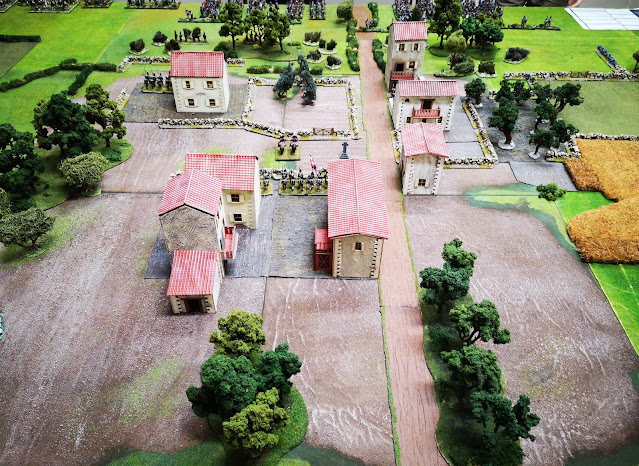
The main objective of the game was the village of Maloyaroslavets and it's bridge over the river Luzha. The village was overlooked, on the Russian side, by a series of ridges providing the french with a steep climb after crossing the river.
 |
| End of the first move. |
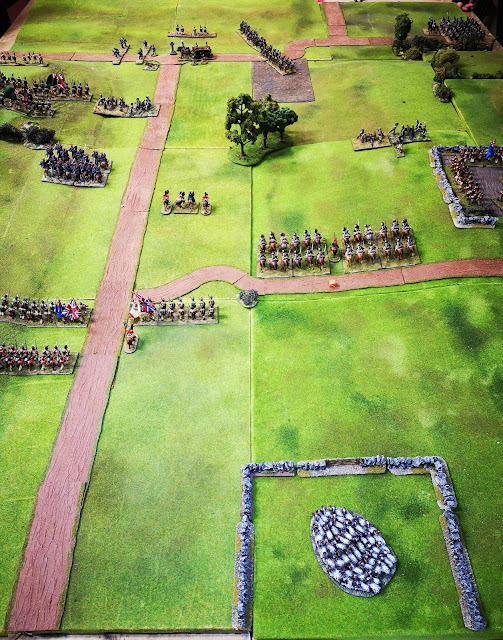
The Russian VI Corps under Dokhturov with support from units of VII Corps started the game in control of the village, two separate built up areas sectors, each garrisoned by a battalion of Jaeger from Kaptsevich's 7th Div, the remainder of this division formed up behind and to the right of the village.
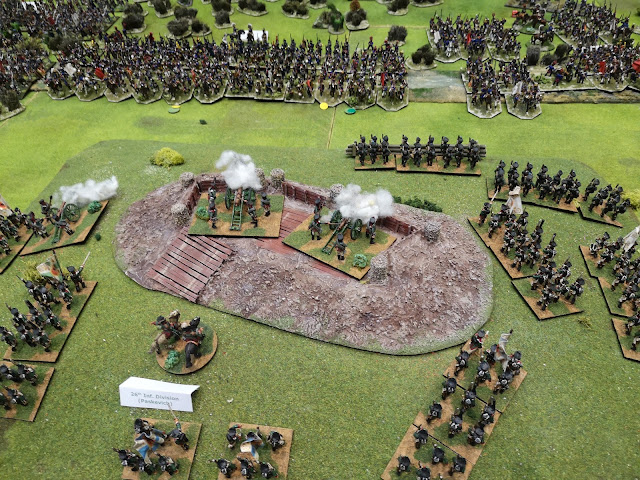
I had command of Vasilchikov's 12th Div which would come on behind and to the left of the village, four battalions of elite jaeger and eight battalions of line infantry plus two batteries.
 |
| 12th Division |
In reserve left of centre we had Paskevich's 24th Div.
The far left flank was guarded by a division of light cavalry and cossacks under the command of Platov
The right wing was held by Lichatcheff's 26th Div. A corps artillery reserve was also avaivable.
Facing us was Prince Eugene's IV Corps with support from two divisions of Davout's I Corps.
French cavalry and artillery could only cross the river at the bridge and then faced a hard slog up a steep slope (2/3rds movement) to the Russians lines. At the base of the slope was an area of dead ground where the french were safe from all Russian fire, unless those units were on the forward edge of the crest.
The French wasted no time in sending battalions straight up the slope to try and gain the village. Meanwhile Italian units crossed the river Luzha to the east and moved to threaten the Russian right flank. French cavalry crossed the bridge and deployed to the west to counter the cossacks
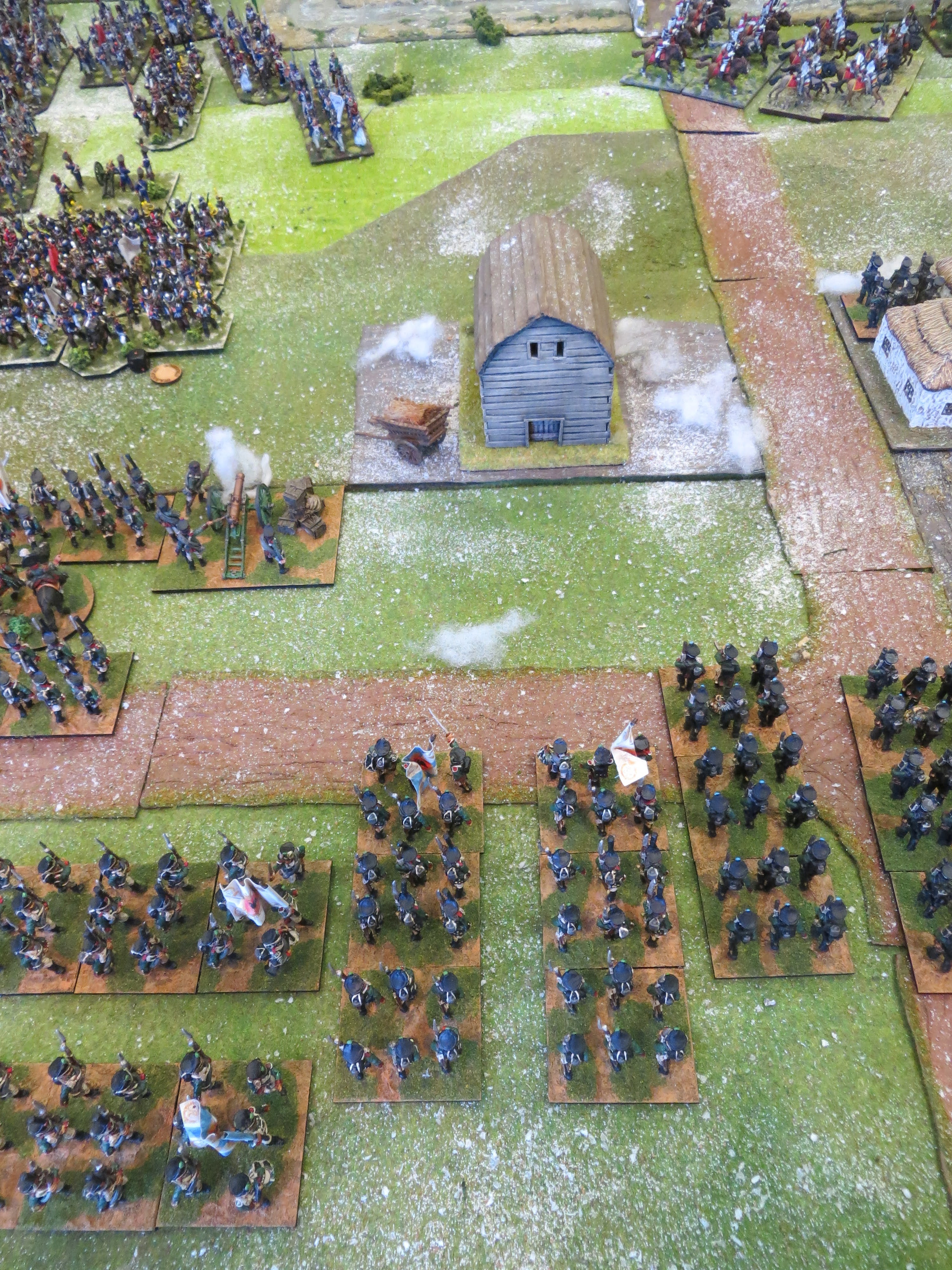
I moved my elite jaeger into position to immediately assault the western half of the village, should it fall, while my artillery and line infantry moved up and formed a line along the crest of the ridge to the west of the village. Our artillery reserve and the rest of the 7th division mirrored this deployment behind and to the east of the village. The reserve troops of 24th division formed behind and to the left of my division with their jaegers taking up skirmishing positions in the woods. The cossacks and light cavalry moved to threaten the French right with the cossacks making hit and run attacks out of the woods as well. The 26th division deployed it's jaeger into the forest to it's found and took up defensive positions and awaited the Italian advance.
The first French assault on the western half of Maloyaroslavets arrived before my line could be formed on the crest and overwhelmed the defenders causing them to flee in terror. First blood to the French.
My four jaeger columns saw this and charged in to oust the upstart French battalion now in control of the buildings, just as planned. That's about as far as that plan succeeded. Despite at least one battalion rolling a 6 for it's attack the French defenders also rolled a 6 so won the combat by one. My units retired and had to roll morale saves, no problem, MR 5 so a 5 or less on a d6......you guessed it three 6s and three battalions melted away just like that shortly followed by the fourth after the brigade morale failed. Bugger.
 |
| French capture half the village and the hole where my jaeger were! |
Fortunately the french assault of the other half of the village faltered leaving the objective split.
With my line troops now along the crest I moved my supporting brigade over to the space vacated by the jaeger and awaited a suitable moment to attack. The next French division soon started up the slope towards my line infantry but because of the movement limitations of the ground had to stop within musket range if they wanted to charge next turn, This left their columns open to musketry and canister from my line, as well as skirmisher fire from the jaeger in the woods to my left.
 |
| French assault along the line. |
 |
| Repositioning my support. |
 |
| View of Maloyaroslavets from the bridge. |
 |
| French support crossing the Luzha river. |
Meanwhile the Russian light cavalry had managed to get the better of the french cavalry on the left flank, forcing them to retreat and then rout. This resulted in several French battalions on the flank having to form square in defence, removing them from the attack up the slope. It also saw the French move their main battery, on the far side of the river, to their right flank to try and drive the harassing horsemen off. This succeeded initially but the cossacks simply dissolved into the woods only to reappear again on the flanks of the forward French units.
 |
| Russian light cavalry harass the French right wing. |
All this time away to the East the French and Italian battalions of Eugene's Corps continued their advance towards the Russian 26th division, slowed by the river crossing then the hills and woods to their front.
Back around Maloyaroslavets the battle for the second half of the village had intensified tot he point where the attacking French division broke and streamed back down the slope towards the river. Seeing this the battalion in the other part of the village pulled back as well leaving the buildings unoccupied. A frantic race to reoccupy these buildings no ensued between the French 4th Division of Desaix and the Russian 12th and 7th Divisions. It all came down to the initiative roll, and fortunately 7th Division won and recaptured the buildings bringing the whole of Maloyaroslavets back under Russian control.
 |
| The race is on! |
 |
| Close combat to my front. |
Whilst this was happening French and Italian dragoons and lancers charged the Russian artillery lines to the east of the village to try and take their attention off of Desaix's forces. While they did manage to overrun a few batteries the close infantry support and reserve guns soon drove them off with heavy losses and the Russians advanced back to the ridge line.
 |
| Charge the guns! as the Italians emerge on the Russian right. |
This now left the remaining French troops advancing in the centre to struggle against solid Russian defences in and around Maloyaroslavets as well as frequent cavalry and jaeger attacks out of the woods on their right flank.
 |
| Final french assault musters. |
 |
| Left flank secure. |
 |
| Last ditch French assault. |
 |
| Canister! |
 |
| Boom!! |
Away to the east Eugene's troops finally fell on the troops of Lichatcheff's 26th Div with great success, initially forcing the far right of the Russian positions to bend back before further troops emerged from the woods and hit the left of Lichatcheff's position where it joined that of Kaptsevich's 7th Div.
Several Russian guns were captured and the right flank was in serious risk of collapse.
At this point with Kaptsevich's 7th Div hastily forming a new right flank, but with Maloyaroslavets firmly in Russian hands, both armies were require to roll for and failed army morale checks. With both armies demoralised and not able to advance anymore the umpire called the game.
With around 10,000 casualties on both sides it was decided that the French would have withdrawn back over the river while the Russians still held Maloyaroslavets giving them a bloody and hard fought victory, much like the historical outcome.
It was great to get back to gaming again and on a large scale. Many thanks to the members who supplied the troops for a great days gaming.
As usual many more photographs and another AAR in the club's
Facebook Album.